

Deck Rails, Decks and Patios, Interior Ideas
Design Workshop: Modern Handrail Details
We saw this article while browsing our page on Houzz. Since we are a stocking dealer with Feeney Cable Rail Systems this article perked our interest. Most of your customers are using the Feeney Cable Rail System for a deck handrail. The interior use of the system showcases a different look we thought is worth sharing.
What to know about material, shape and customizable options when designing a handrail

In the design of stairs and their details, informed minimalism makes good sense. We prioritize safety and function first and foremost, and our building codes dictate many of the dimensions we must use. The width, tread run, riser height, guardrail and handrail conventions, and even a handrail’s cross section and circumference are regulated. Within those safety and functional constraints, the following modern examples still manage to delight the senses.
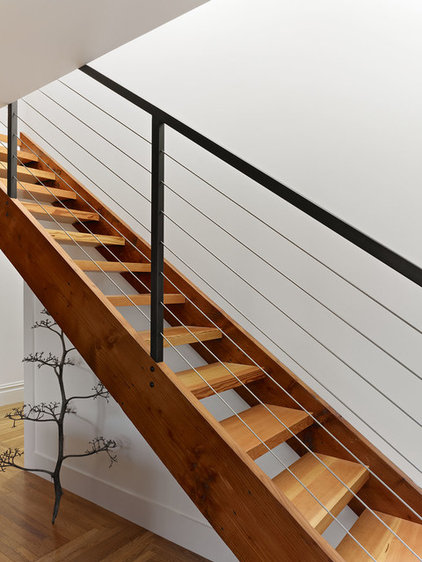
As a general rule, a handrail is required in residential construction on any stair with three or more risers. It must be present on at least one side of the stair at a minimum height of 34 inches but no more than 38 inches above the front of the tread.Stairs exceeding 30 inches in height and open on one side also require a guardrail. Typically guardrails are required to be 42 inches high with openings no larger than 4 inches in diameter. Many jurisdictions allow the handrail assembly to double as a guardrail, as it does in this image, in which case it can be positioned at handrail height (34 to 38 inches). (Consult your local code requirements; they may be more stringent than this.) Where possible, this is the preferred method, because there are fewer overall parts required.
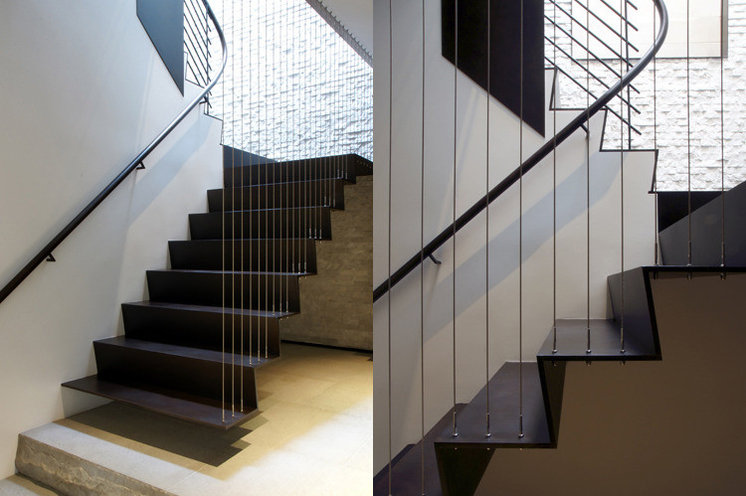
The basic decisions regarding any handrail design fall into a few general categories.
- Custom, standardized, hybrid: Will the design be tailored to a specific design goal, or will it be made of standardized components, or both?
- Material: Wood, metal, glass, rope, hybrid
- Shape: Round, rectangular, square, custom
- Support: Brackets, wall, floor, self-supporting, hybrid
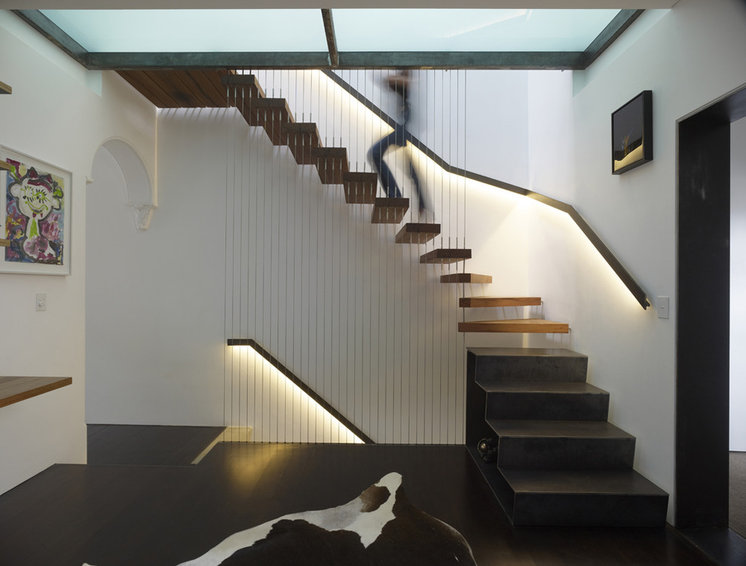
Custom SolutionsBecause stairs are inherently unique elements, they often require a customized design to ensure that a project’s precise design objectives can be met. In tight spaces, custom solutions make the most sense, because they maximize the functionality within the given parameters.The stair shown here is openly expressive of the code constraints dictating its design. The last 30 inches of the stair don’t require a guardrail, so it has been omitted, opening up the space. The handrail, however, is required to be uninterrupted for the full run, so it continues on. It has also been designed to conceal the functional need for lighting the stairway.
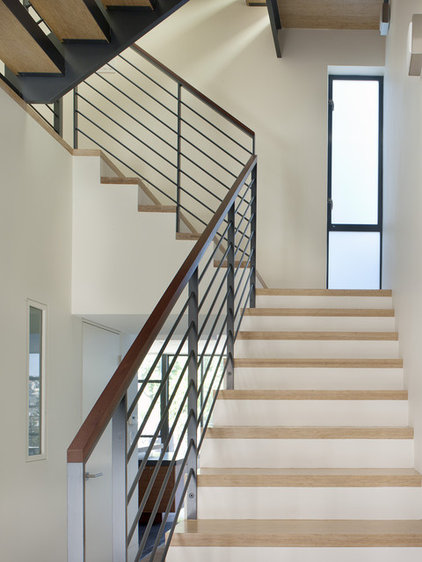
Choosing a custom solution doesn’t necessarily rule out the use of standardized components, like the flat bar stock comprising the handrail supports in this design. It only marries them more precisely to the design condition. Using standard-size components helps to make it more affordable.
